
Independent Clare TD pleads for funding for mental health services
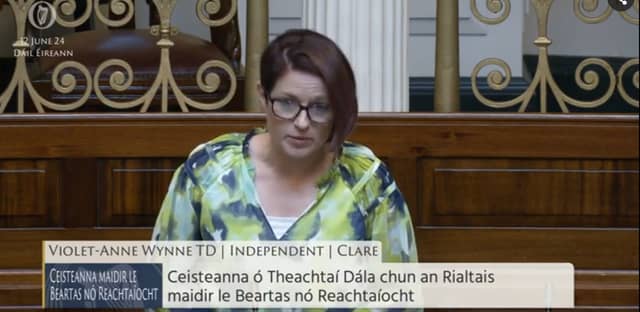

Clare Independent TD Violet-Anne Wynne has issued a statement highlighting the poor state of mental health services across Ireland, especially the effects on young people and the Mid-West being left behind.
"Our struggling health service is not a new issue. There has been a 10% increase in UHL attendances from January to May 2024 compared to same period last year," she said.
Deputy Wynne cited a World Health Organisation (WHO) commission on social connection that states Ireland is "the loneliest country in the EU, and the fourth worst for teen suicide".
"In 2023, 173 children and young adults presented at UHL after suicide or self harm attempts, the highest number since records began," her statement read.
“Minister for State at the Dept of Health Colm Burke pointed out that only 2% of Irish young people need CAMHS support,” says Deputy Wynne. “According to the World Health Organisation, 14% of 10-19 year olds will experience some form of mental disorder. I put to the Minister: Do only 2% of Irish youth require support, or is there a significantly higher proportion that suffer in silence until they take matters into their own hands?”
According to the Independent Clare TD, Families for reform of CAMHS found it took 80-209 days after a suicide attempt for their children to receive treatment, depending on which CHO (Community Healthcare Organisations, a HSE geographic division) they were in.
Minister of State at the Dept of Health Mary Butler told the Chamber on 27 June 24 it was essential we do not have a mental health postcode lottery; Deputy Wynne contends that we are already there.
"27% of those hospitalised for eating disorders, the deadliest mental illness, were in hospitals with no ED trained staff. 83% had no access to a therapist or psychiatrist after their discharge; is it any wonder 41% would be readmitted for the same problems within two years?"
"Minister Donnelly promised three things to solve the Mental Health crisis: more CAMHS teams, regional CAMHS hubs, and a dual diagnosis team. He has started work on all three, but because of the recruitment embargo he continues to defend, none are fully resourced.
"Of the promised five CAMHS Hubs, one is open and one is in development (it will not surprise anyone that the open Hub is in County Dublin) and the rest are waiting indefinitely for recruitment. The promised Mid-West dual diagnosis hub has eight hired staff, three pending recruitment, and two places that await resourcing. Our Hub is 60% staffed and the work on the promised Parteen centre cannot begin because resources have not been allocated for it.
"The Psychiatric Nurses Association have given notice of intent to strike, and it is difficult blame them. We have 725 vacancies for psychiatric nurses, up from 300 before the embargo. Data shows it takes up to two months to go from a job offer to starting work – if the recruitment embargo ended today, we would still spend months letting critical services limp along.
"The Interim Report of the Mental Health Commission highlighted that the rates for acceptance of referrals from GPs to CAMHS varied hugely between 38% and 81%, laying the blame on the postcode lottery.
Deputy Wynne said she was "dismayed and disgusted at these numbers."
“If 62% of children trying to access early intervention are being turned away at the door, some are going to turn up on the ED floor.”
"This is a problem that could have been predicted in 2016, when the state mental health policy promised 129 CAMHS teams to cover the country. We have never reached that number; we currently sit at 75, and Mary Butler told the Dáil last year that her Dept were discussing reducing that to 50."
Deputy Wynne ended with the following grim message: “If we are not investing in early intervention – if our CAMHS teams continue to be divided by region with little to no link up or crossover – if our health service continues to be under resourced, understaffed, and overexerted – then this government will be writing their next batch of empty promises in blood.”
Read more Health stories on Clare Live