
Short-term lets register ‘took longer than it should have’, Tanaiste says


There has been no Cabinet infighting over a register, Simon Harris said.
There has been no Cabinet “infighting” over a short-term lets register, the Tánaiste has insisted.
A draft national planning statement on short-term lets, such as Airbnbs, was agreed by the Cabinet and will now be notified to the European Commission.
The planning statement will set out national policy on applications for planning consent for new short-term letting of residential property, and for retention consent for existing short-term lets.
The planning statement underpins the Short-Term Letting and Tourism (STLT) Bill and the Short-term Let Register, to come into effect from December 1.
Anyone offering paid accommodation for up to 21 nights will be required to register each unit they rent out with Fáilte Ireland, which could be an entire property or a room within a home.
Anyone applying to be on the register will have to declare the space complies with statutory obligations, including planning permission when required.
There have been reports of disagreements at Cabinet over the legislation, including to which areas it would apply and the effect it would have on tourism-dependent communities.
Speaking to reporters on Tuesday morning, Tánaiste Simon Harris dismissed the reports.
He said: “There was no infighting but what there was was a real need to get this right – because we’re trying to do two things here and we need to make sure one thing doesn’t knock off the other.
“We’re trying to make sure that there are more properties available to long-term let, particularly in cities and towns, and that there’s a regulation and structure around short-term lets that’s coming in at an EU level that, quite frankly, hadn’t happened before.
“We’ve got to also balance that with the fact that there are many parts of this country – including rural communities, small towns, small villages – where short-term lets is a key part of the domestic tourism economy, where they may not have access to many hotels.”
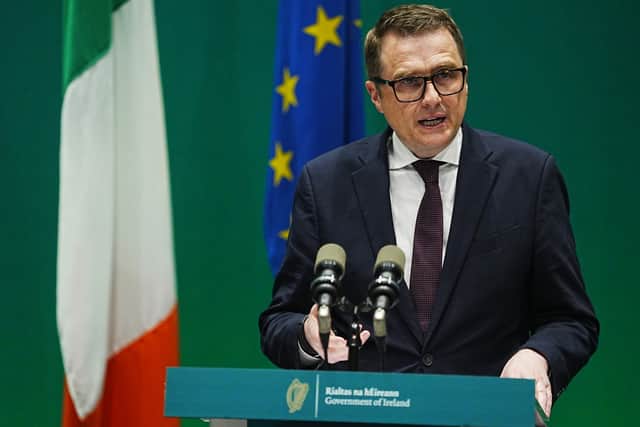
Mr Harris accepted “it took a little bit longer than it should have” but insisted ministers had got the balance “right”.
A Housing Agency Report estimated through Airbnb data that there are 28,903 short-term lets in Ireland, with the cities representing about 40% of the national total.
Dublin accounts for 9,186 short-term lets, or 32% of the total.
New planning permissions for short-term lets will not be needed in cities and towns with a population above 20,000 according to the most recent Census.
This includes Dublin, Cork, Limerick, Waterford and Galway, and 20 large towns.
For residential properties that have operated as a short-term let for at least seven years and no enforcement action has been taken, planning permission for retention can be sought.
“The Government is proceeding with its regulation of the short-term letting sector – with a strong focus on balancing the crucial need for more long-term rental accommodation with the competing needs of the tourism sector,” Mr Browne said.
“New short-term lets will generally not be allowed in cities and large towns, so homes remain available for people who need long-term housing.
“As with any new registration process, a national authorisation scheme must be in place, in this case in the form of the necessary planning permission.
“This Planning Statement ensures clarity and consistency in the implementation of planning policy nationally with regard to planning consenting short-term lets.”
“In towns and settlements of under 20,000 population, the policy approach will be more amenable to allowing the short-term letting,” said Minister of State John Cummins.
“This National Planning Statement will guide planning authorities in assessing planning applications for the short-term letting of residential property – considering factors such as the housing needs in the area, possible urban regeneration benefits and tourism accommodation needs.”