
Providing tents to refugees ‘not a good idea’, Tanaiste says


It is “not a good idea” for charities to provide tents to unaccommodated asylum seekers, the Tanaiste has said.
Micheal Martin said he believes there is a “problem” with non-governmental organisations providing tents to refugees who have yet to receive an offer of accommodation from the State.
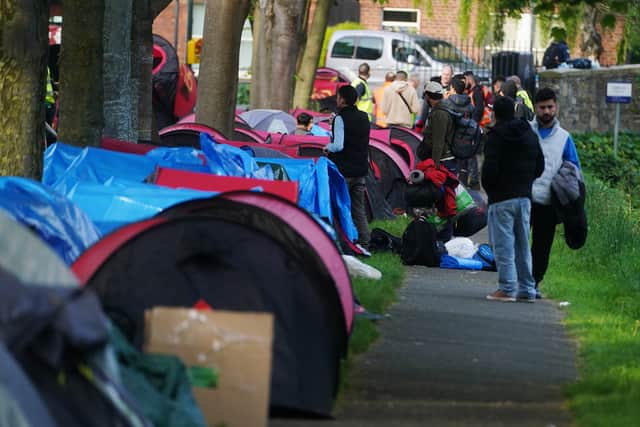
There are currently 1,780 male international protection applicants who have not received an offer of State-provided accommodation.
Charities have provided tents to some of the asylum seekers who have not been provided with shelter by the State.
The Government provides funding to some of the organisations that have provided the tents.
Many of the unaccommodated refugees chose to erect their tents in clusters around Dublin, forming makeshift encampments around the International Protection Office and, later, along the Grand Canal.
The Government ordered multi-agency operations to clear the camps and relocate the international protection applicants.
However, more tents have since been pitched on a different stretch of the waterway.
Speaking on Wednesday, Mr Martin said his experience from working with charities on the issue of homelessness was that other organisations are “not in favour” of providing tents.
He said the practice is fundamentally unsafe and also carries risks around sanitation.
Asked about whether it made sense for the Government to fund charities that provide tents to the migrants while it is also attempting to clear encampments, Mr Martin said: “There is a conflict and there’s a problem there, I acknowledge that.
“In my own view, tents are not a good idea anyway.
“I witnessed that during different phases of homelessness, where many established homeless organisations were not in favour of the giving out of tents to homeless because it led to other challenges, and was actually unsafe.
“And there’s a fundamental issue of lack of sanitation and safety around the pitching of tents in any kind of location within a city or a town.
“The short-term solution is the securing of a significant State-owned site where we can facilitate proper tents with proper sanitation and basic supplies.”
Speaking on Newstalk, he added: “That is what we have been doing but we’re going to have to create more because the numbers that have come into the first three months, at the moment, is nearly double what came in the last three months last year.”
Asked if the provision of tents in the city centre needed to be stopped, Mr Martin said: “In respect of non-governmental organisations, they operate to their own ethos and so on but I do think we need to engage with them in relation to their practice.
“I think there is a fundamental problem that we do have to address.”
Roisin McAleer of Social Rights Ireland, which has been working with international protection applicants in the camps, said: “The Tanaiste is either misunderstanding the reality of homelessness or deliberately engaging in a game of smoke and mirrors.
“Homeless charities distribute tents only as a last resort. Tents pitched on city streets or parks are obviously not a solution and constitute a grave risk to human safety and dignity.”
Ms McAleer said that it is “profoundly cruel” to prohibit the pitching of tents or instruct charities not to distribute them in the absence of a stable alternative.
“This would be tantamount to a revival of the anti-vagrancy laws of the 19th century that criminalised poverty and sent millions of Irish people to the workhouse.
“The alternative we propose is to open up the numerous empty buildings around Dublin city that are in the ownership of the State, starting with the Baggot Street Hospital.”
Minister for Public Expenditure Paschal Donohoe said the Government will have to examine the circumstances in which tents are being made available, in what numbers, and their purpose.
“I think the Tanaiste is making an important point that we are going to have to consider. It’s about getting the balance right,” he said.
“On one hand, if we don’t make tents available to people we run the risk of them not having any shelter at all. We run the terrible risk of them be totally open to the elements, unable to secure themselves and run the risk of a level of homelessness and an experience of homelessness that I certainly do not want to see happen.
“On the other hand, the availability of these tents in the numbers that they have been available also leads to other problems that we’ve had to grapple with.
“We have to look at the circumstances in which tents are being made available, in what numbers and what their uses are once they’re made available.
“We are trying to avoid people who are coming to our country in terrible circumstances, being completely vulnerable and that’s why the tents are being made available in the first place.
“But we are going to have to engage with NGOs (Non-governmental organisations) and other parts of the state to see how that can be done in a way that is safer and all involved.”