
Parnell Square stabbing accused told gardaí he was a ‘sick person’, jury hears


A man accused of attempting to murder three children told Irish police he was a ‘sick person’ who needed help, the jury in his trial has heard.
A man accused of attempting to murder three children told Irish police he was a “sick person” who needed help, the jury in his trial has heard.
Riad Bouchaker, 52 and of no fixed address, is charged with the attempted murder of two girls and one boy, and assault causing serious harm to an adult, at Parnell Square East in Dublin City on November 23 2023.
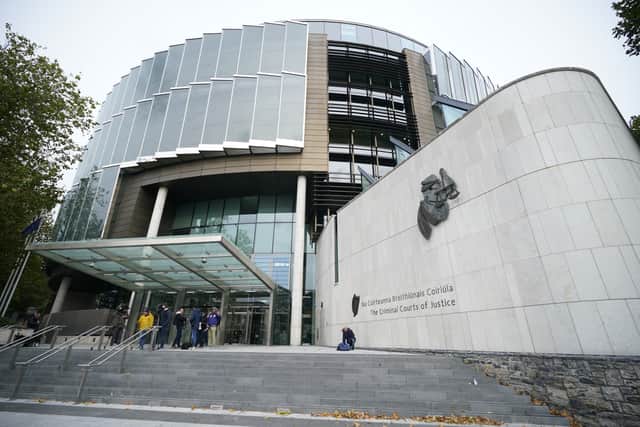
On the 10th day of the trial at the Central Criminal Court in Dublin, members of the jury were read transcripts and shown CCTV footage of interviews between him and members of the Irish police service An Garda Síochána almost a month later in December 2023.
Through an interpreter, Bouchaker said he was “upset” at a negative social welfare decision, but added he “did not mean to hurt anybody”.
He explained he felt like “this country is telling me to leave” and told gardaí he was “sick”, not in his “right mind”, and did not “want to kill or harm the children”.
The jury previously heard Bouchaker had brain surgery in 2021 and suffered a further head injury during the interventions of members of the public which required hospital treatment for roughly a month.
The members of the jury were previously told he now has an “acquired brain injury”.
In the interviews played on Tuesday, Bouchaker was cautioned and told he did not have to provide any answers but anything he did say may be used in evidence.
The jury also heard that Bouchaker received a letter, dated November 15, advising him that his application for basic supplementary welfare allowance would be closed or disallowed if he failed to provide certain documents by November 22.
Bouchaker told gardaí he “got mad” after he got the “social welfare refusal letter” and that he wanted to show that he was “well fit for work”.
He said he had been sick for 19 years.
The accused was shown CCTV footage of his movements on November 23 question and asked if he remembered his actions.
On one occasion relating to throwing away a pair of shoes, he said: “If they only helped me, this wouldn’t have happened.”
He later said: “I am a sick person.
“Whoever watches the incident would know I am sick and need help.”
Bouchaker told the gardaí “I feel these are my children” and said he never wanted to hurt them.
The jury heard he also said: “The incident was the outcome of the suffering I had for many years.”
Bouchaker was also shown footage of him visiting a mosque, where he said he left a suitcase containing his clothes which he wanted to donate.
He said the suitcase also had his Algerian and Irish passports which he had intended for his brother to collect.
He told gardaí that he goes to other mosques and had “never” been inside that mosque before.
He said he was “overwhelmed” and “felt like Ireland didn’t want me” so he packed up his stuff.
Bouchaker said that the clips were helping bring back his memory of what happened on that day.
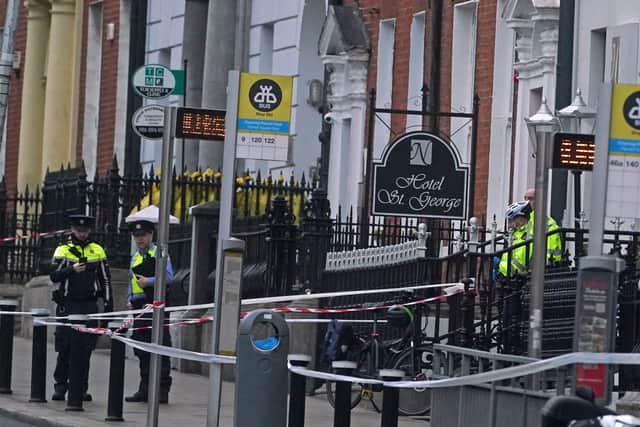
Asked by gardaí why he went to Parnell Square, he said he had previously lived at a hostel there.
Asked a further question about Parnell Square, the jury heard he said: “I said to myself I would go there, take the knife, but I would not kill anyone.”
He said he never had intentions to hurt anyone and said he had never been a problem with the system or authorities.
In an earlier interview, Bouchaker’s interpreter told gardaí that the accused said he had a “fish memory” when asked about the events of November 23.
The translator said the accused said he “did something” and referred to a hand gesture of holding something in his hand, adding: “I know I did something bad but I’m sure I did not kill or want to kill or harm the children.”
Asked what was in his hand, Bouchaker said it was a knife.
Further asked to explain where he got the knife, he said it was “brand new” and he wanted to take it with him back home to Algeria.
When gardaí asked him to explain what he meant by “something bad”, Bouchaker told them through the interpreter that: “For 14 years, I have been applying. They said no.
“It sounded like this country is telling me to leave. I was upset, I put my hand here and then I did not mean to do what happened.”
Bouchaker said he found himself “shaking”.
He added: “I don’t know what’s happened. I know I’m sick and the doctor said I’m sick.”
When shown what gardaí said they believed to be packaging for the knife, the interpreter said: “He’s saying ‘please guys kill me, it has been 180 years of waiting’.”
Bouchaker, through the interpreter, also said: “That girl, I am ready for whatever the family wants.”
The translator later added: “He wants me to tell you this: ‘I did something that I feel I was dead when I did it’.
“Whatever they want, I never meant to kill anybody. I am an Irish national.
“The social welfare refusal decision made me go into blackout and my brother told me ‘what’s wrong with you and you are not this kind of person’.”
In one interview, Bouchaker said the letter had to do with a disability allowance he had applied for.
He said he had discussed the letter with his brother, became “mad” and tore it up.
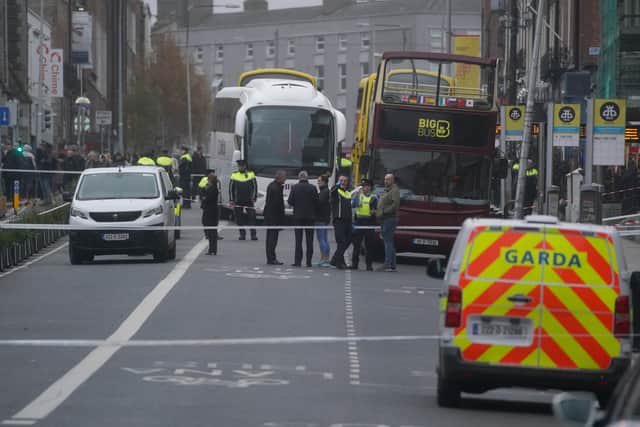
Gardaí showed Bouchaker CCTV footage from Parnell Square East where he identified himself in the clips.
The interpreter said that from “putting two and two together” and “half phrases” that Bouchaker had said: “I did something wrong and I was upset because of the negative decision I got from the social welfare but I did not mean to hurt anybody.”
He said he had never did anything similar in his life and was “happy” the girl “was saved”.
He described the actions in the CCTV as someone who was “mental”, later adding “it wasn’t my mind”.
Through the interpreter, he said: “I don’t know why I did that.
“My mind feels like there is no brain in my head.
“It feels like it is squeezed, smashed and do whatever you want with me, guys.”
He said he was not conscious of what he was doing and “not in my mind at all”.
Asked “why children” by gardaí, the interpreter said he responded that they “did nothing to deserve what happened to them but it wasn’t me in my right mind”.
He said it was the parents who are the ones who “got hurt most” and added he would “never do that” in his conscious mind.
The interpreter told Gardaí he said: “I know myself. I was not in my right mind. And I’ve never done anything of that sort in my life.”
The trial will continue on Friday.